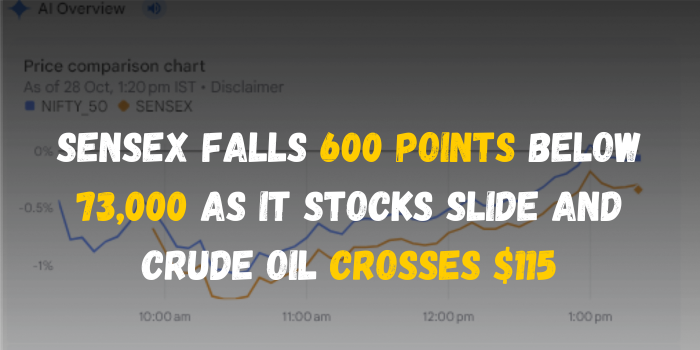
Indian stock markets faced significant selling pressure on Wednesday, October 28, as rising crude oil prices, escalating US-Iran tensions and uncertainty ahead of the US Federal Reserve's interest rate decision weighed on investor sentiment.
The BSE Sensex fell as much as 826 points during intraday trading, while the NSE Nifty 50 dropped more than 200 points, slipping below the 22,600 mark. Information technology stocks led the decline, with Infosys, Tech Mahindra and Tata Consultancy Services (TCS) among the major contributors to the benchmark indices' losses.
The Nifty IT index declined around 3.2%, while the Nifty FMCG index fell 1.22%. Broader market performance was mixed, with the Nifty Smallcap 100 slipping 0.16% and the Nifty Midcap 100 trading 0.35% higher, according to the figures reported during the session.
Investors remained cautious as global economic and geopolitical developments increased uncertainty about inflation, corporate earnings and the direction of interest rates.
4 Key Reasons Behind the Stock Market Fall
1. Crude Oil Prices Rise Above $115 Per Barrel
The rise in international crude oil prices was one of the biggest concerns for Indian equity markets. Brent crude climbed above $115 per barrel on Wednesday amid fears of potential supply disruptions in the Middle East and renewed geopolitical tensions.
Higher oil prices can have a significant impact on India because the country depends heavily on imported crude to meet its energy requirements.
An extended increase in oil prices can raise India's import bill, put pressure on the rupee and increase inflationary risks. Businesses may also face higher transportation, manufacturing and operating expenses, potentially reducing profit margins.
Sectors that depend heavily on fuel and transportation costs could face additional pressure if crude prices remain elevated. Concerns about these economic effects contributed to the cautious mood among investors.
2. US-Iran Tensions Increase Global Market Uncertainty
Geopolitical tensions involving the United States and Iran added to investor concerns on Wednesday. Reports of possible renewed US military action against Iran raised fears that the conflict could escalate and disrupt regional energy supplies. However, a decision to launch a fresh military campaign had not been confirmed in the supplied report.
The Strait of Hormuz is another important factor in the market outlook because it serves as a major route for international oil and liquefied natural gas shipments.
Any disruption to energy transportation through the region could push crude prices higher and increase uncertainty across global financial markets.
For India, prolonged tensions could affect inflation, currency stability and business costs. Investors therefore remained sensitive to developments in the Middle East, particularly the possibility that further escalation could keep energy prices elevated.
3. Profit Booking and Cautious Trading After Derivatives Expiry
Profit booking also contributed to the cautious trading environment following Tuesday's derivatives expiry.
After periods of market gains or volatility, traders may sell positions to secure profits and reduce their exposure to sudden price movements. Such activity can intensify selling pressure when negative global developments are already weighing on investor confidence.
The combination of elevated crude prices, geopolitical uncertainty and weakness in major IT stocks encouraged some market participants to adopt a more cautious approach.
However, profit booking was only one of several factors influencing the session. The decline also reflected broader concerns about the global economic outlook and the potential impact of higher energy prices on Indian companies.
4. Investors Await the US Federal Reserve's Interest Rate Decision
The US Federal Reserve's monetary policy announcement was another major factor keeping investors cautious.
Markets were widely expecting the Fed to leave its benchmark interest rate unchanged in the range of 3.75% to 4%. Investors were also looking for guidance on the central bank's future policy direction, particularly its assessment of inflation and the outlook for borrowing costs.
If the Fed signals that interest rates may remain elevated for longer than expected, US bond yields and the dollar could strengthen. This could make equities less attractive to some investors and affect foreign investment flows into emerging markets, including India.
On the other hand, a more balanced policy outlook could ease concerns about global financial conditions.
The Fed's statement and its assessment of economic risks were therefore important considerations for investors deciding whether to increase exposure to equities or remain cautious.
IT Stocks Lead the Decline in Benchmark Indices
Information technology shares were among the weakest performers during Wednesday's trading session.
Infosys, Tech Mahindra and TCS were among the major stocks weighing on the Sensex and Nifty. The Nifty IT index fell approximately 3.2%, making it the worst-performing sector in the reported market snapshot.
The weakness in IT shares added to the pressure on the benchmark indices, even as some mid-cap stocks showed resilience.
The divergence between large-cap IT stocks and parts of the broader market suggested that selling pressure was concentrated in particular sectors rather than affecting every segment of the market equally.
What Should Investors Watch Next?
Market direction will depend on developments across several domestic and international factors. Investors are likely to monitor the following indicators closely:
- Crude oil prices: Whether Brent crude remains above $115 per barrel or retreats from elevated levels.
- US-Iran developments: Any escalation or diplomatic progress that could affect energy supplies.
- Federal Reserve guidance: Signals about future interest rates, inflation and financial conditions.
- Foreign investment flows: Buying and selling activity by foreign institutional investors.
- Corporate earnings: Quarterly results and management outlooks that could influence stock valuations.
- IT sector performance: Whether major technology stocks stabilise after the sharp decline.
These factors could influence investor sentiment and determine whether the market experiences further volatility or a recovery.
Conclusion
The October 28 stock market decline was driven by a combination of rising crude oil prices, US-Iran tensions, profit booking and caution ahead of the US Federal Reserve's policy announcement. Weakness in major IT stocks added to the pressure on the Sensex and Nifty.
The immediate market outlook remains sensitive to geopolitical developments, energy prices and signals from the Fed. Investors should distinguish between short-term market volatility and changes in the long-term outlook of individual companies before making investment decisions.
Disclaimer: This article is for informational purposes only and does not constitute investment advice.